Posts

Word of the Week: Canonisation

Image
Word of the Week: Canonisation (of Saints) An Orthodox Patristic Understanding   “God is wondrous in His saints” (Psalm 67:35 LXX) The term “canonisation,” commonly used in Western Christianity, especially in the Roman Catholic Church, to denote a formal, juridical act of declaring someone a saint, must be approached with great caution and nuance within the Orthodox tradition. The Orthodox Church neither understands nor practices “canonisation” in the legalistic or forensic manner that developed in the post-Scholastic West. Rather, she speaks of glorification (dóksa, δόξα) and recognition (anagnṓrisis, ἀναγνώρισις) of holiness already manifest among the faithful. This is not a process of making someone a saint, but of affirming through prayerful discernment and ecclesial consensus that someone has already become a saint by grace, by their union with Christ, and by the fruit of the Holy Spirit borne in their life and even after death. The Nature of Holiness and the...

WORD of the Week Series: Love

Image
Early 19th Century Icon, Russian “Union of Love” (Sourced from Temple Gallery Catalogue Christmas 2004) WORD of the Week: Love (Love in Truth) A Scriptural and Patristic Understanding “ Let us not love in word or in speech, but in deed and in truth .” – 1 John 3:18 Introduction: Love Misunderstood in the Modern World The modern age has stripped the word love of its sacred weight, reducing it to sentimentality, psychological affinity, or erotic desire devoid of ontological content. In political rhetoric, love becomes an empty slogan. In contemporary culture, it is commodified or psychologized. Yet Holy Scripture and the Church Fathers offer a radically different vision— love in truth ( agapē en alētheia , ἀγάπη ἐν ἀληθείᾳ)—an existential and divine energy, a way of being proper only to God and those in communion with Him. Scriptural Foundations: Love Is of God In the New Testament, agapē is not an option but a divine imperative, a reflection of God’s own essence: “God...

WORD of the Week: Christian

Image
WORD of the Week: Christian An Orthodox Patristic Definition “And in Antioch the disciples were first called Christians.” — Acts 11:26, ESV  “It is not the name, but the way of life that makes a Christian.” —St. Ignatius of Antioch, Epistle to the Magnesians To be called a Christian (Gk, Christianos, Hbw, Meshichi) in the Orthodox Patristic tradition is not a cultural label, an ideological subscription, nor a moral, identity. The term was originally --in all likelihood-- a neutral label or possibly one with dismissive or even mocking connotations at the time.   It is, rather, an ontological and ecclesial reality: the Christian is one: 1. Who has been united to Christ (Christos),  2. who lives by His life, and  3. who is progressively transformed into His likeness through divine grace (charis), synergistic asceticism (synergeia), and sacramental communion in the life of the Church (Ekklēsia). The name Christian was not a self-appointed title, nor was it ado...

Saint Paphnutius of Borovsk, Hegumen & Miracle-worker

Image
Paphnutius of Borovsk – A True Orthodox Translation was just published on  trueorthodox.eu .  You can view the full article here: https://trueorthodox.eu/new-pu blication-the-life-akathist-of -st-paphnutius-of-borovsk-a-tr ue-orthodox-translation/

EDITORIAL OPINION - Should Laity Craft Ekklesial & Monastic Goods

Image
EDITORIAL OPINION  Monastic Economics and the Ethics of Sacred Craft: A Canonical-Patristic Evaluation of Lay Production of Ecclesial Goods and Monastic Support  “ Render unto God the things that are God's .” – Matthew 22:21  The increasing commercialization of ecclesial goods—monastic clothing, liturgical vestments, metalwork, woodcarving, and other sacred crafts—by lay persons has emerged as both a pastoral concern and an ecclesial anomaly in the twenty-first century. It brings to the fore vital questions concerning ecclesiastical order, the ethics of spiritual commerce, and the theological vocation of both laity and monastics. While the impulse to serve the Church through craftsmanship is commendable, the unregulated participation of lay entrepreneurs in traditional monastic trades raises serious concerns about exploitation, desacralization, and disobedience to the canonical and ascetical norms of Orthodox tradition.  This paper undertakes a canonical, theological...

WORD of the Week: Perichoretic

Image
  WORD of the Week: Perichoretic (Patristic definition and elaboration) The term perichoretic derives from the Greek περιχώρησις (perichōrēsis), a word formed from peri- (around) and chōreō (to make room, to go forward, to contain, or to make space). In the theological lexicon of the Church Fathers, perichōrēsis came to signify the mutual indwelling, interpenetration, or co-inherence of the divine persons of the Holy Trinity —Father, Son, and Holy Spirit—without confusion, division, or loss of personal distinction. Though the word itself does not appear in the New Testament, its meaning is woven into the fabric of Christological and Trinitarian theology. The Church Fathers—particularly the Cappadocians, St. John of Damascus, and St. Maximus the Confessor—developed the concept as they wrestled with safeguarding the paradox of unity and distinction in the Godhead. In its most precise and sacred application, perichōrēsis describes the eternal and dynamic communion among the three hypo...

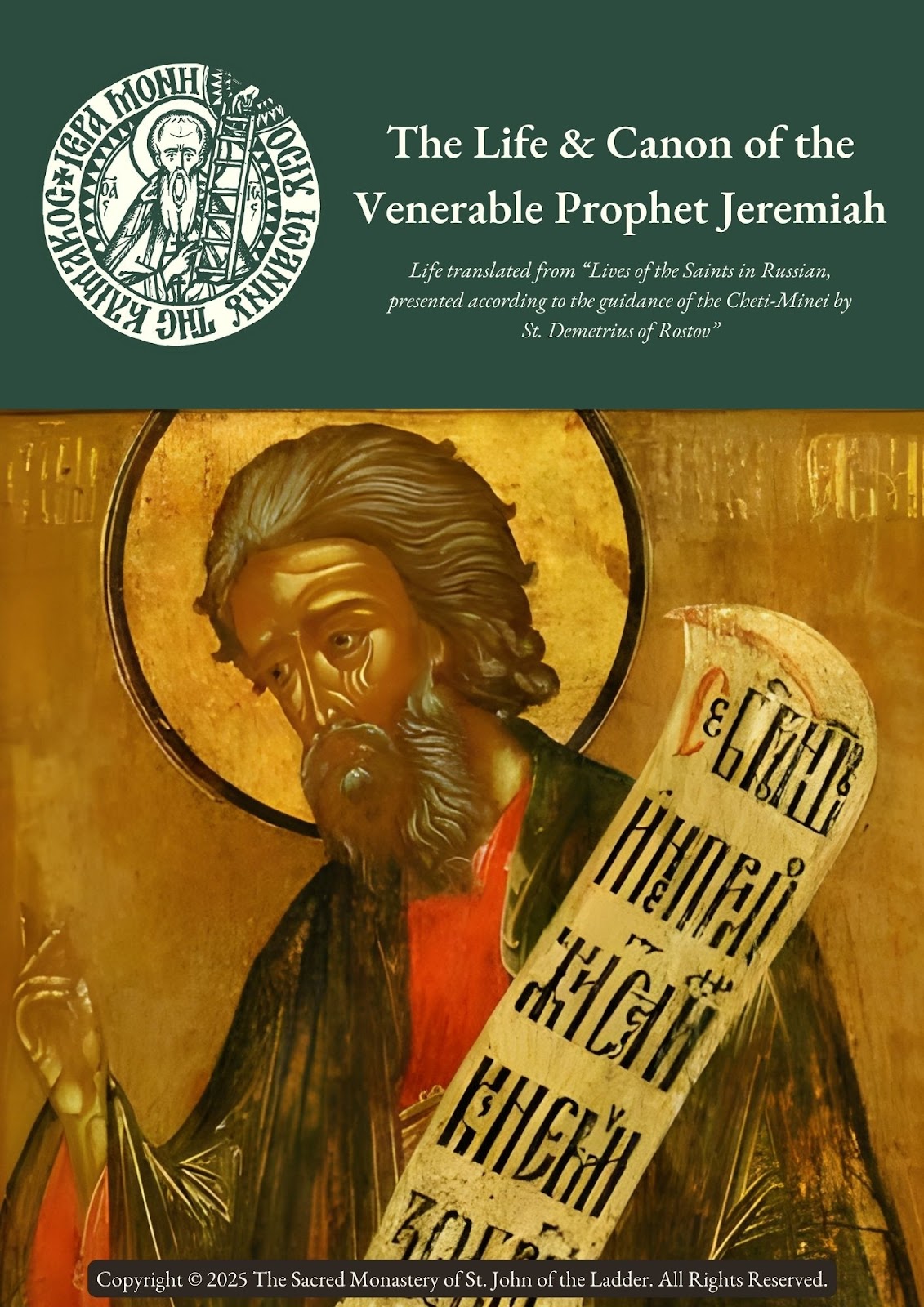
Life & Canon of the Holy Prophet Jeremiah

Image
from the Russian True Orthodox Church (RTOC)         Western Europe Diocese Life & Canon of the Holy Prophet Jeremiah: A True Orthodox Translation 

WORD of the Week series: Synergy & Logoi

Image
 WORD of the Week: Synergy & Logoi “ God is faithful, by whom you were called into the fellowship (koinōnia) of his Son, Jesus Christ our Lord. ” —1 Corinthians 1:9 The words Synergy (συνεργία, synergeía) and Logoi (λόγοι, logoi) belong to the deep marrow of Orthodox Patristic theology. To speak of them together is to enter the very heart of the mystery of man's participation in God, the human person's ascent into hypostatic being through cooperation with Divine Energies. In Orthodox thought, Synergy refers to the cooperative action (συν-εργεία, "working together") between human freedom and Divine Grace . It is not a merger of equals, nor a mutual necessity as if God required man; rather, it is the divinely willed cooperation wherein man's free response is called forth and empowered by the divine initiative. As Saint Paul proclaims, “ We are God's fellow workers ” (1 Corinthians 3:9). Saint Maximus the Confessor explains this synergy in terms of the wi...

Love in the Face of Heresy

Image
  Love in the Face of Heresy:  A Genuine Orthodox Christian Reflection by Stavroforemonk Symeon Agiomicheltítēs “Brethren, stand fast, and hold the traditions which ye have been taught, whether by word, or our epistle” (2 Thess. 2:15, KJV). In every age of the Church’s life, the manifestation of love is inseparably tied to the defense of Truth. Love that abdicates the Truth is not love at all, but a subtle betrayal of Christ Himself, who declared, “I am the way, the truth, and the life” (John 14:6). Genuine Orthodox Christians (GOC), following the Apostolic and Patristic tradition, have not ceased to proclaim the dangers of heresy precisely because they are bound by Love—a love that refuses to allow souls to drift into darkness unchecked. It is a failure of charity to remain silent when the saving dogmas of the Church are attacked, undermined, or distorted. Among heretics and critics, a persistent accusation resounds: that by continually exposing the errors of modernity—whethe...

WORD of the Week: Participation

Image
 WORD of the Week a new weekly series defining and elaborating on a significant term used by the Church Fathers and Patristic-oriented Orthodox Theologians. Participation Click here to read 

Editorial Christ is Risen, Pope Francis is Dead

Image
Editorial ----  On the Repose of Pope Francis at the Convergence of Easter & Pascha “O death, where is thy sting? O grave, where is thy victory?” (1 Cor. 15:55) There are moments in history when the convergence of events speaks more powerfully than any declaration; moments when Providence permits a juxtaposition so striking that it becomes a judgment—not necessarily of condemnation, but of sobering significance. The recent repose of Pope Francis—hypothetically occurring on the very day when both Roman Catholic Easter and Orthodox Pascha were observed together—marks such a moment. It demands of us, not euphoric speculation, nor sentimental ecumenism, but a piercing theological discernment rooted in Orthodox truth, patristic sobriety, and ecclesial vigilance. That such a death should occur at the liturgical intersection of East and West , and during a season marked by unprecedented overtures between the Vatican and the Phanar, is no mere historical coincidence. Fo...

Paschal Sermon

Image
  The Catechetical Sermon of St. John Chrysostom  If any man be devout and love God, let him enjoy this fair and radiant triumphal feast. If any man be a wise servant, let him rejoicing enter into the joy of his Lord. If any have labored long in fasting, let him now receive his recompense. If any have wrought from the first hour, let him today receive his just reward. If any have come at the third hour, let him with thankfulness keep the feast. If any have arrived at the sixth hour, let him have no misgivings; because he shall in nowise be deprived thereof. If any have delayed until the ninth hour, let him draw near, fearing nothing. If any have tarried even until the eleventh hour, let him, also, be not alarmed at his tardiness; for the Lord, who is jealous of his honor, will accept the last even as the first; He gives rest unto him who comes at the eleventh hour, even as unto him who has wrought from the first hour. And He shows mercy upon the last, and cares for the first; ...

The Account of the Harrowing of Hell

Image
 The Account of the Harrowing of Hell Taken from The Gospel of Nicodemus read here

Sermon of St. Epiphanius of Cyprus for Holy Saturday

Image
A Sermon of our Father among the Saints, Epiphanius, Archbishop of Cyprus  on the Burial of the divine Body of our Lord and Saviour Jesus Christ, on Joseph of Arimathæa and Nicodemus, and on the Lord’s Descent into Hell, which occurred in wondrous manner after his saving Passion read here

On the Ecclesial Legitimacy of the True Orthodox Church

Image
  On the Ecclesial Legitimacy of the True Orthodox Church: A Patristic and Relational Ontological Response to Accusations of Schism a PDF copy may be downloaded here

To Die Before You Die

Image
  “To Die Before You Die” by Stavroforemonk Symeon Agiomicheltítēs “Precious in the sight of the Lord is the death of His saints.” — Psalm 116:15 (LXX) “He who fears death is not a Christian, for Christ has trampled down death by death.” — St. Athanasius of Alexandria, On the Incarnation “O life, how can You die? How can You dwell in a tomb? Yet by Your death You destroyed the reign of death, and raised up all the dead from Hades.” — Lamentations of Holy Saturday, Stasis II The idea of death, the fear of it, haunts the human animal like nothing else; it is a mainspring of human activity — activity designed largely to avoid the fatality of death, to overcome it by denying in some way that it is the final destiny for men… It is fateful and ironic how the lie we need in order to live dooms us to a life that is never really ours.”  — Ernest Becker The dread of death is the universal ache of fallen man. Ernest Becker’s psychological treatise, The Denial of Death , identifies this f...

Divine Liturgy Beyond Space & Time

Image
 Participating in the Divine Liturgy Beyond Space & Time: A Patristic and Ecclesial Reflection on Digital Presence, Infirmity, and the Ontology of Worship Stavroforemonk Symeon Agiomichēlitēs  Abstract: This article explores the Patristic and Orthodox understanding of participation in Divine Worship, particularly in light of contemporary digital phenomena and the pastoral needs of the infirm and isolated. Engaging with the theology of St. Maximus the Confessor, St. John Chrysostom, St. Gregory Palamas, and others, it argues for a robust distinction between sacramental participation and noetic participation, emphasizing the eschatological and ontological dimensions of liturgical life. The article also reflects on how grace may extend beyond physical boundaries without compromising the incarnational and sacramental nature of Orthodox ecclesiology.   Introduction The Divine Liturgy in the Orthodox Church is not an aesthetic performance or devotional exercise; it is a th...